The Flyby That Changed a Spacecraft's Trajectory
On May 15, 2026, NASA's Psyche spacecraft pulled off one of the most critical maneuvers of its entire mission: a precision flyby of Mars. Skimming just 2,864 miles (4,609 km) above the Martian surface, the spacecraft used the planet's gravity to increase its speed and bend its trajectory — setting it on a direct course for the main asteroid belt.
But this wasn't just a navigation trick. The flyby gave mission scientists a rare opportunity to test every instrument aboard Psyche against a well-studied planet before the spacecraft reaches its ultimate target: a mysterious metal-rich asteroid also named Psyche, scheduled for arrival in summer 2029.
"This gravity assist was years in the making, and the navigation team nailed it."
— Bob Mase, Psyche Project Manager, NASA JPL
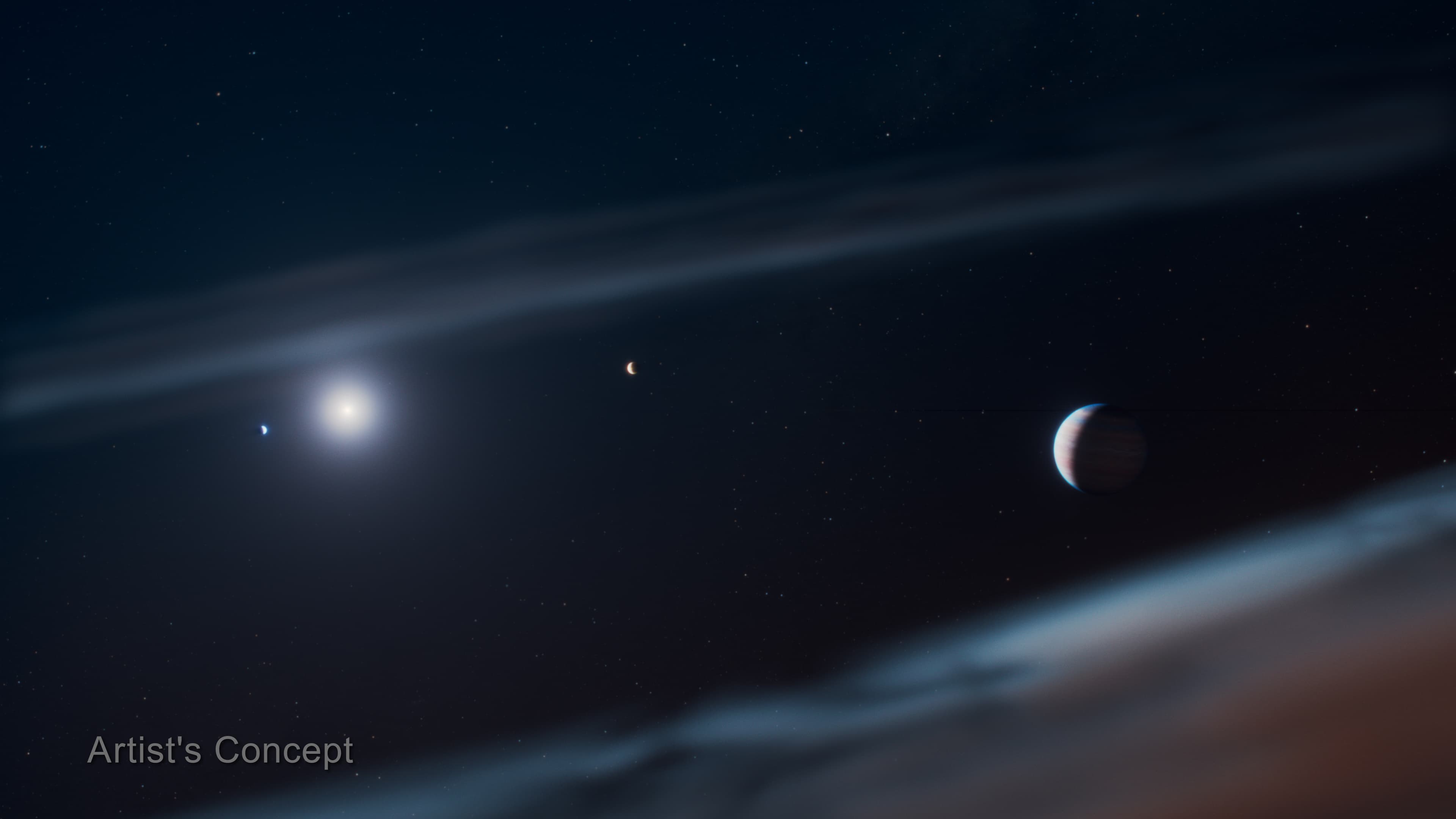
 Psyche spacecraft concept near Mars
Artist's concept of a spacecraft performing a Mars flyby. NASA's Psyche performed this exact maneuver on May 15, 2026. (Credit: NASA/JPL-Caltech)
A Timelapse Like No Other
Psyche's multispectral imager — two identical cameras designed to photograph asteroid Psyche in multiple wavelengths — captured a stunning month-long sequence as the spacecraft approached and departed Mars.
Because Psyche approached Mars at a high-phase angle, the planet first appeared as a narrow, bright crescent. Sunlight scattering through the Martian atmosphere created a striking glowing edge. As the spacecraft drew closer, the cameras resolved:
- Wind-shaped craters carving patterns across the surface
- The south polar ice cap gleaming in reflected light
- The massive double-ringed Huygens crater
The full sequence was assembled into a timelapse video that NASA released shortly after the flyby.
"The imager performed brilliantly, delivering some rarely seen views of the Red Planet."
— Jim Bell, Psyche Imager Instrument Lead, Arizona State University
Detecting Neutrons From Mars
One of the flyby's most impressive technical achievements came from the gamma-ray and neutron spectrometer. This instrument is designed to identify chemical elements on asteroid Psyche by measuring neutrons and gamma rays released when cosmic rays strike a planetary surface.
At Mars, the instrument faced a challenge: it was too far away (2,864 miles) to detect gamma rays. But scientists believed it might still register neutrons escaping from the Martian surface and atmosphere.
It worked.
"Around the time of Mars closest approach, the neutron spectrometer detected a count-rate enhancement close to what we anticipated. It was very gratifying to see."
— David Lawrence, Science Lead for Psyche's Spectrometer, Johns Hopkins APL
This successful detection proved the instrument is functioning correctly and validated the team's models — a critical milestone before the spectrometer is turned toward the unknown composition of asteroid Psyche.
Mapping Mars' Magnetic Shield
Psyche's magnetometer has been collecting data since launch in 2023, mostly measuring the magnetic field carried by the solar wind. The Mars flyby marked the first time it measured the magnetic signature of a celestial body.
As Psyche passed close to Mars, the instrument registered an intense spike in magnetic field strength — the signature of the bow shock region, where the solar wind slams into Mars' magnetic field at supersonic speed.
"This flyby calibration effort validated the instrument's performance under dynamic conditions while also revealing the fascinating physics of planetary magnetism."
— Ben Weiss, Psyche Deputy Principal Investigator, MIT
 Mars magnetic field illustration
An illustration representing planetary magnetic fields. Psyche's magnetometer measured Mars' bow shock region during the flyby. (Credit: NASA)
Hunting for Moonlets: Phobos and Deimos as a Test
In a clever rehearsal for future science operations, the imager team used the flyby to spot Phobos and Deimos — Mars' two tiny moons — from extremely far away.
This was a direct practice run for the mission's planned search for moonlets around asteroid Psyche. If the asteroid has small orbiting bodies, Psyche's cameras need to be able to detect them at great distances. Mars' moons served as the perfect stand-in target.
The successful detection confirmed that the imager's sensitivity to scattered light is well-calibrated for the moonlet search that will begin when the spacecraft reaches its target in 2029.
Calibrating Against the Fleet
To validate the imager's performance, the Psyche team is comparing their flyby observations with data collected by a small army of other Mars missions:
- NASA: Mars Reconnaissance Orbiter, 2001 Mars Odyssey, Curiosity rover, Perseverance rover
- ESA: Mars Express, ExoMars Trace Gas Orbiter
- UAE: Hope Orbiter ( Emirates Mars Mission)
These cross-mission comparisons will help the team understand exactly how Psyche's cameras perform before they're turned toward a target no spacecraft has ever visited up close.
Why Asteroid Psyche Matters
The asteroid Psyche — the spacecraft's namesake — orbits in the main asteroid belt between Mars and Jupiter. What makes it extraordinary is that it appears to be almost entirely metal — primarily iron and nickel.
Scientists believe Psyche could be the exposed metallic core of a planetesimal, an early building block of a rocky planet. If confirmed, studying Psyche up close would be like x-raying a planet's core — offering a window into the violent processes that shaped Earth and the other terrestrial planets billions of years ago.
| Mission Parameter | Detail |
|---|
| Launch Date | October 13, 2023 (SpaceX Falcon Heavy) |
| Mars Flyby | May 15, 2026 |
| Flyby Altitude | 2,864 miles (4,609 km) |
| Speed Boost | Gravity assist toward main asteroid belt |
| Target | Asteroid 16 Psyche |
| Arrival | Summer 2029 |
| Key Instruments | Multispectral imager, magnetometer, gamma-ray/neutron spectrometer |
| Lead Institution | Arizona State University / NASA JPL |
What's Next
Following the successful gravity assist, Psyche is now traveling directly toward the asteroid belt. The spacecraft will resume sustained thrusting with its solar-electric propulsion system later in 2026, gradually building up speed for the remaining three-year cruise.
When Psyche finally arrives at its target in 2029, every instrument will have been tested, calibrated, and validated against Mars — ensuring that when humanity gets its first close look at a metal world, the science will be flawless.
Why This Video Matters
The timelapse video released by NASA isn't just beautiful — it's proof of concept. Every frame confirms that Psyche's instruments are ready for the main event. For space enthusiasts, this flyby represents one of those rare moments where a mission halfway through its journey delivers scientific value before reaching its destination.
The full timelapse is available on NASA's YouTube channel, and it's the kind of content that reminds us why space exploration captures the human imagination: a spacecraft built to study the unknown, taking a detour past one of our closest planetary neighbors to prove it's ready for the journey ahead.