A Planet No One Has Seen
There is a planet that might not exist. It has never been photographed. It has never been seen through a telescope. No infrared signal has confirmed its heat. No reflected light has bounced off its surface. And yet, for almost a decade, some of the most respected astronomers in the world have been arguing about it — because the math says it should be there.
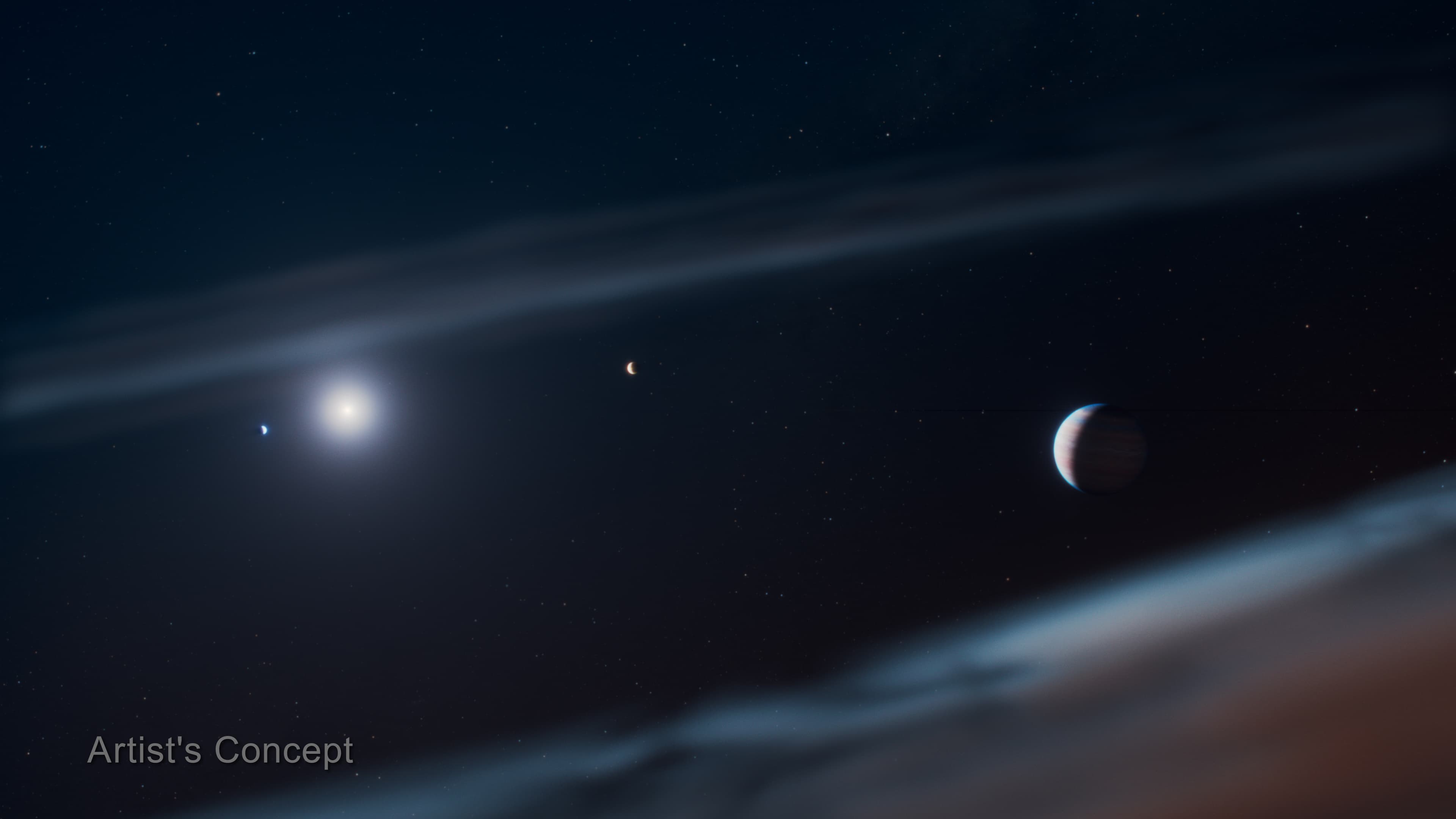
They call it Planet Nine. Not Pluto (that was demoted). Not a dwarf. A full, massive world — perhaps five to ten times the mass of Earth — orbiting the Sun at a distance so extreme that a single year there lasts 10,000 to 20,000 Earth years.
The evidence is not a photograph. It is a pattern.
The Paper That Started Everything
On January 20, 2016, Caltech astronomers Konstantin Batygin and Michael E. Brown published a paper in The Astronomical Journal that sent shockwaves through planetary science. The title was straightforward: "Evidence for a Distant Giant Planet in the Solar System."
The substance was not.
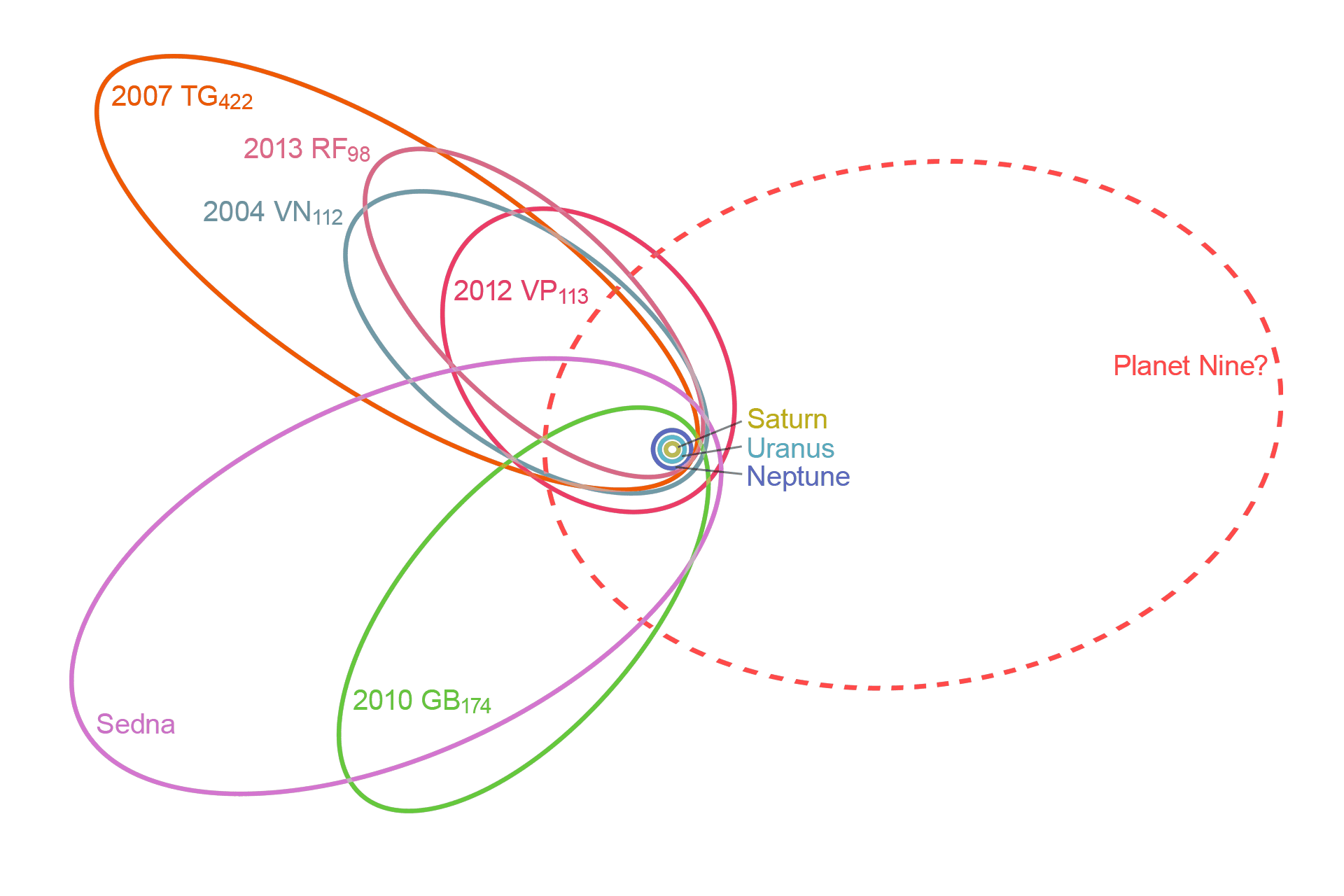 Planet Nine's hypothesized orbit around the Solar System — Caltech/R. Hurt
Brown — famous for demoting Pluto, earning him the nickname "Pluto Killer" — and Batygin, then an assistant professor, had been studying the orbits of extreme trans-Neptunian objects (ETNOs): icy bodies orbiting far beyond Neptune. Six of these objects, each with a semi-major axis greater than 250 AU and perihelia beyond 30 AU, shared something uncanny. Their perihelia were clustered within 94° of each other, centered near 318°. Their orbital planes were tilted at nearly the same angle — averaging 22° to the ecliptic.
This was not supposed to happen. In a random distribution, such alignment would occur by chance fewer than 1 in 10,000 times. The combined probability of both the perihelion and inclination clustering happening randomly was less than 0.01%.
Something was herding these objects. Something massive. Something distant.
What Planet Nine Would Look Like
If Planet Nine exists, it is not what most people imagine when they hear "ninth planet."
Based on the orbital dynamics, Brown and Batygin estimated:
- Mass: ~10 Earth masses in the original 2016 paper; refined to 6.2 +2.2/−1.3 Earth masses (roughly 4.9–8.4 M⊕) in a 2021 reanalysis
- Semi-major axis: 380 +140/−80 AU (range: ~300–520 AU)
- Perihelion: 300 +85/−60 AU (range: ~240–385 AU)
- Orbital inclination: 16 ± 5°
- Orbital period: ~10,000–20,000 years
For context, Neptune orbits at about 30 AU. Planet Nine would be 10 to 17 times farther from the Sun than Neptune. At that distance, sunlight is essentially nonexistent — the planet would be a dark, frozen world, visible only by its own faint thermal glow in the far-infrared.
It would not look like Jupiter. It would not have colorful bands or a great red spot. It would be a super-Earth — a category of planet common around other stars but never confirmed in our own solar system. Cold, rocky or possibly icy, and shrouded in permanent darkness.
The 90° Population: A Prediction Confirmed
One of the most striking predictions from the Planet Nine hypothesis came in 2016, when Batygin and Brown published a follow-up paper in The Astrophysical Journal Letters. They predicted that Planet Nine's gravitational influence should produce a population of objects with orbits nearly perpendicular to the ecliptic plane — a 90° tilted population that no one had looked for.
They were found.
Highly inclined Centaurs with semi-major axes of 300–700 AU and perihelion distances less than 80 AU showed orbital properties matching the predictions. The mechanism was not the familiar Kozai effect but a secular resonance involving a linear combination of orbital angles: Δϖ – 2ω. Simulations showed that 38% of stable objects in the Planet Nine scenario undergo this perpendicular evolution at least once.
This was a bold prediction. And it was confirmed observationally. For proponents of Planet Nine, it was the strongest evidence yet that the hypothesis was more than a statistical anomaly.
Ammonite: The Object That Complicated Everything
Then came Ammonite.
Officially designated 2023 KQ₁₄, Ammonite was first observed in March, May, and August 2023 using the 8.2-meter Subaru Telescope atop Mauna Kea, Hawaii, as part of the FOSSIL (Formation of the Outer Solar System: An Icy Legacy) survey. Follow-up observations with the Canada-France-Hawaii Telescope in July 2024 confirmed the orbit, and archival data traced it back 19 years — to at least 2005.
Published in Nature Astronomy on July 14, 2025, Ammonite became the fourth known sednoid — a class of extreme trans-Neptunian objects named after Sedna, the first discovered. Its key statistics:
- Diameter: 220–380 km (assuming geometric albedo 0.05–0.15)
- Perihelion: ~66 AU (more than twice Neptune's distance)
- Aphelion: ~252 AU
- Apparent magnitude: 25.4
Here is why Ammonite matters: its orbital apsides are anti-aligned with the other three known sednoids. While Sedna, 2012 VP₁₁₃, and Leleākūhonua all have perihelia clustered in the same region of sky, Ammonite's perihelion points in the opposite direction — at 271° versus the 0°–90° range of the others.
Simulations by Yukun Huang (National Astronomical Observatory of Japan) showed that Ammonite would likely be ejected from its orbit by a planet in the predicted Planet Nine position. And Ying-Tung Chen's 2025 simulations, run without any Planet Nine, found a 97% probability that Ammonite's orbit was previously aligned with the other sednoids approximately 4.5 billion years ago.
Dr. Yukun Huang (NAOJ): "The fact that 2023 KQ₁₄'s current orbit does not align with those of the other three sednoids lowers the likelihood of the Planet Nine hypothesis."
Dr. Shiang-Yu Wang (ASIAA): "Ammonite's orbit tells us that something sculpted the outer Solar System very early on. Whether it was a passing star or a hidden planet, this discovery brings us closer to the truth."
Ammonite did not kill the Planet Nine hypothesis. But it made the picture significantly more complicated.
The Vera Rubin Observatory: The Final Test
For a decade, the Planet Nine debate has been fought with statistics, simulations, and small-number arguments. That is about to change.
The Vera C. Rubin Observatory, perched at 2,682 meters on Cerro Pachón in Chile, is the most powerful survey telescope ever built. Costing approximately $800 million (funded by NSF, DOE, and private sources), it carries a 3.2-gigapixel camera — the largest digital camera ever constructed — behind an 8.4-meter mirror.
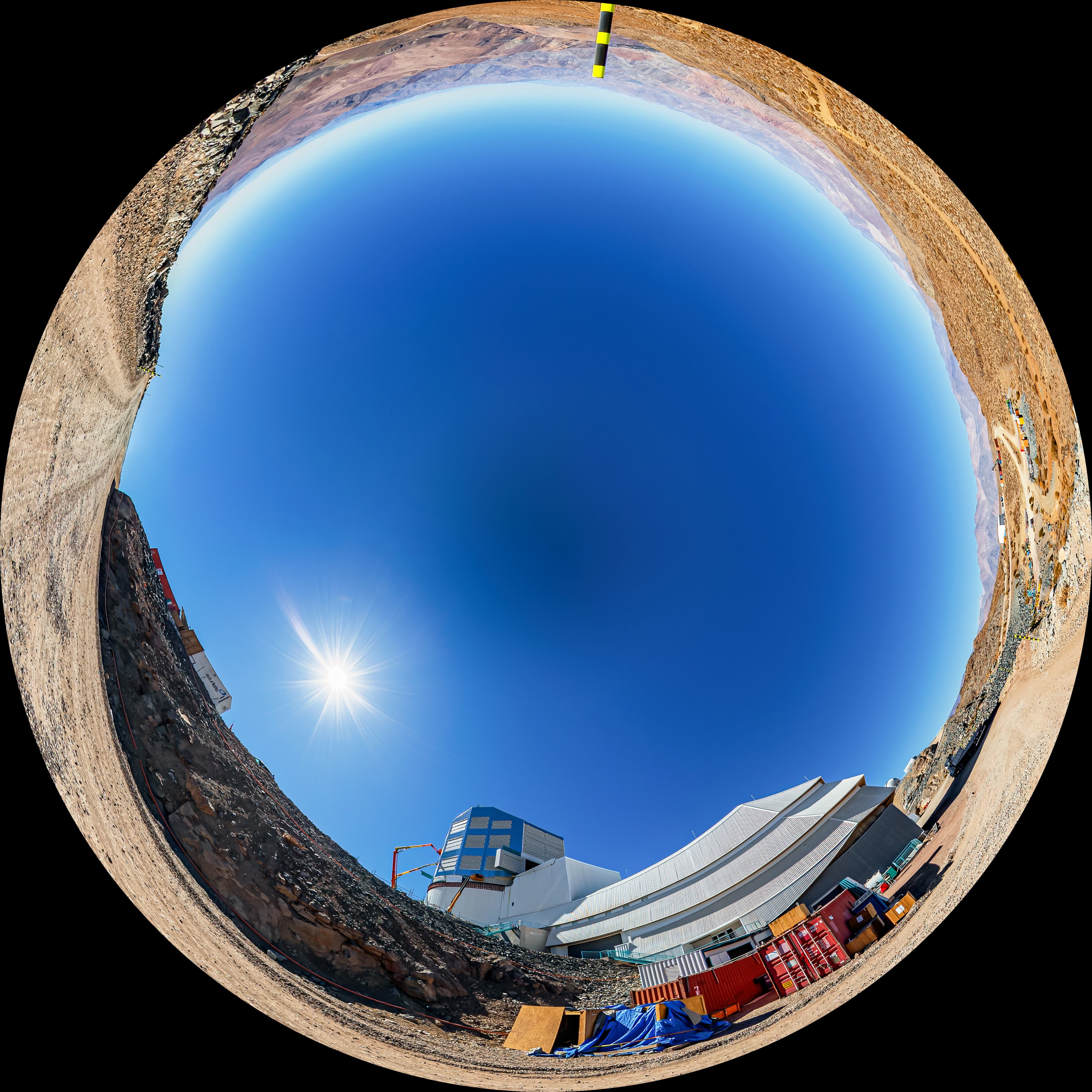 Vera Rubin Observatory, Cerro Pachón, Chile — NOIRLab/NSF/AURA
Its mission: the Legacy Survey of Space and Time (LSST) — a 10-year campaign to map the entire observable southern sky every 3–4 nights with 30-second exposures.
The timeline has been building to this moment:
- 2025 — First light achieved
- July 2025 — Science commissioning began
- March 2026 — Final commissioning phase
- June 29, 2026 — LSST formally began (confirmed by NSF-DOE press release)
During a February 2026 commissioning run, Rubin issued over 800,000 alerts in a single night — detecting objects that moved or changed brightness against template images. Planet Nine, at magnitude 21–22, would be roughly 1,000 times fainter than Pluto — comfortably within Rubin's detection range.
The observatory uses difference imaging: every new frame is compared to a stored template, and anything that moves or varies is flagged automatically. Planet Nine would appear as a slow-moving point source drifting a few arcseconds per year — exactly the kind of signal Rubin is designed to catch.
Michael Brown (Caltech): "If you were to hand me a billion dollars to build a telescope to find Planet Nine, I would give it back because the Vera Rubin Observatory is absolutely perfect."
Even without directly spotting the planet, Rubin will detect an estimated 37,000 new trans-Neptunian objects — expanding the current catalog by roughly 10 times. That expanded sample will allow Batygin to further constrain the perturber's properties through its gravitational footprint alone.
The scientific community expects a definitive answer by late 2027.
The 70–80% Chance
How likely is it that Planet Nine actually exists?
Scott Sheppard of the Carnegie Institution — one of the original TNO discoverers who found "The Goblin" (2015 TG387) — offered an estimate in an April 2025 NPR interview:
"If Planet Nine is real, this observatory has around a 70 to 80 percent chance of finding it... it's not a sure thing because there are so many uncertainties."
Those uncertainties include the planet's exact distance, size, and surface reflectivity. The search area has been narrowed to less than 10% of the original sky prediction. If the visible-light search comes up empty, the focus will shift to far-infrared signatures.
For proponents, the bias-corrected clustering significance stands at 99.6% confidence — meaning there is roughly a 1 in 500 chance the observed orbital alignment is a statistical fluke. For critics, that margin is not enough when the sample size is so small.
The Other Side: Alternative Explanations
Not everyone is convinced.
Observational bias is the most common objection. Kevin Napier and colleagues at the University of Michigan published a 2021 study in The Planetary Science Journal titled "No Evidence for Orbital Clustering in the Extreme Trans-Neptunian Objects." They argued that when data from three different surveys were combined, the apparent clustering was consistent with a uniform, unclustered population — once you account for where each survey was looking.
Samantha Lawler of the University of Regina, part of the OSSOS (Outer Solar System Origins Survey) collaboration, put it bluntly: "Data for these most extreme objects is completely consistent with a random distribution... I really don't think there is any clustering."
Other alternative explanations include:
- Primordial black hole: Jakub Scholtz and James Unwin (2019) proposed that Planet Nine could be a grapefruit-sized black hole with 5–6 Earth masses — producing the same gravitational effects without emitting light
- Axion star: Di et al. (2023) suggested an axion star of comparable mass could reproduce the dynamical effects
- Modified gravity (MOND): Some researchers invoke Modified Newtonian Dynamics to explain orbital alignment without a massive perturber
- Primordial stellar encounter: The Sun may have been born in a stellar cluster; a passing star could have sculpted the outer Solar System during formation
A 2024 study integrating the orbits of the three sednoids backward found they were all tightly clustered approximately 4–4.5 billion years ago — independent of observational bias. This "primordial alignment" could mean a formation-era event, not a currently present planet, sculpted their orbits.
What Happens Next
The debate has reached its decisive moment.
The Vera Rubin Observatory's LSST is now operational. By late 2027, it will have surveyed the entire southern sky hundreds of times over. If Planet Nine exists within the predicted mass and distance range, Rubin will almost certainly find it — or rule it out.
If detected, it would be the first new planet in the solar system since Neptune in 1846 — a discovery that would reshape our understanding of planetary formation, orbital dynamics, and the architecture of our cosmic neighborhood.
If not detected, the hypothesis will face its hardest test yet. The clustering signal would remain. The 90° population would remain. But without a direct detection, the astronomical community may begin to accept that something else — bias, a primordial event, or physics we do not yet understand — is responsible.
Either way, we will know soon.
Timeline
- January 20, 2016 — Batygin and Brown publish "Evidence for a Distant Giant Planet in the Solar System" in The Astronomical Journal.
- 2016 — Prediction of a 90° tilted population of trans-Neptunian objects.
- 2019 — Brown and Batygin publish bias-corrected clustering significance at 99.6% confidence.
- 2021 — Refined parameters: 6.2 Earth masses, 380 AU semi-major axis.
- 2021 — Napier et al. publish counter-study finding no evidence for clustering.
- 2019 — Scholtz and Unwin propose primordial black hole alternative.
- March–August 2023 — Ammonite (2023 KQ₁₄) first observed with Subaru Telescope.
- July 2024 — Ammonite orbit confirmed with CFHT.
- April 2025 — Scott Sheppard estimates 70–80% detection probability with Rubin.
- July 14, 2025 — Ammonite published in Nature Astronomy, complicating the Planet Nine hypothesis.
- 2025 — Long Phan and Goto identify a far-infrared candidate in IRAS/AKARI data (unconfirmed).
- June 29, 2026 — Vera Rubin Observatory formally begins LSST.
- Late 2027 — Expected definitive answer on Planet Nine's existence.
Sources: Batygin & Brown, The Astronomical Journal 151:22 (2016); Brown & Batygin, arXiv:2108.09868 (2021); Huang et al., Nature Astronomy (July 2025); Scott Sheppard, NPR (April 2025); Napier et al., The Planetary Science Journal (2021); Vera Rubin Observatory / NSF-DOE press release (June 2026); Scholtz & Unwin (2019); Caltech press releases. Imagery: NASA/JPL, NOIRLab/NSF/AURA, Wikimedia Commons.